
When Should You Replace Work Boots?
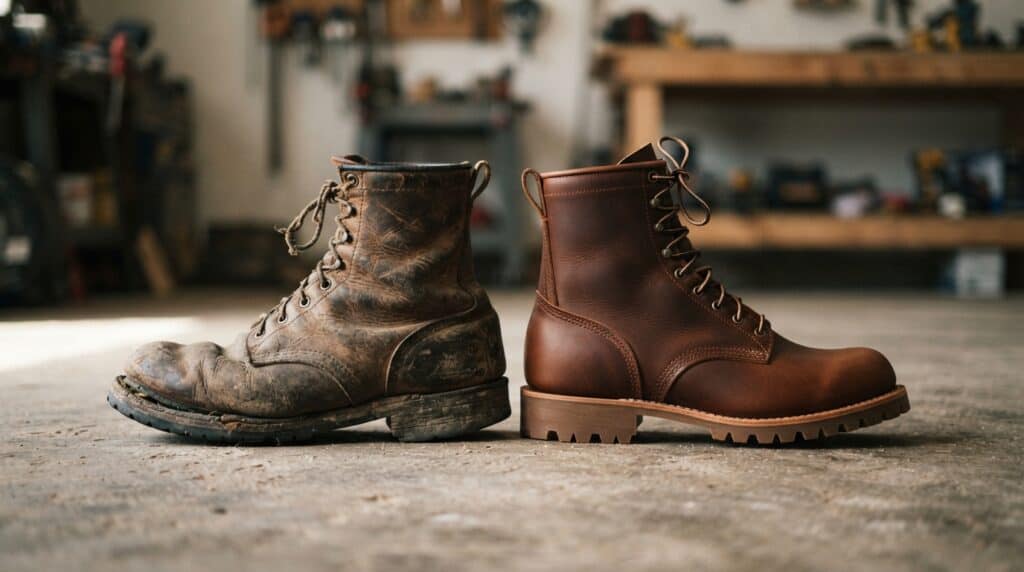
Replace work boots immediately if the toe cap is cracked or exposed, the sole is separating from the upper, tread is worn smooth, or an EH-rated sole shows heavy wear — these are safety failures, not cosmetic ones. For non-safety wear (dead cushioning, persistent new foot pain), replacement is still warranted even if the boot “still works,” typically somewhere between 6 months and 2 years depending on job intensity.
Work boots rarely fail all at once — they degrade gradually, which makes it easy to keep wearing a pair past the point where they’re actually protecting you. Here’s how to know it’s genuinely time, using checks you can do yourself in under a minute.
Three Quick Physical Tests
The Toe-Fold Test
From underneath, push up on the toe of the boot, bending it toward the laces, then release. The toe should lift only slightly, in roughly the front third of the sole, and spring back to its original position. If the sole folds up dramatically or the toe can touch the laces, the sole no longer offers sufficient support.
The Heel Counter Pinch Test
Grasp both sides of the heel counter (the structured cup around your heel) and pinch them together. There should be some give but real firmness — the sides shouldn’t be able to touch. If they can, the heel counter has lost the structural support it’s supposed to provide.
The Water Bead Test
Pour a small amount of water on the leather. If it beads and rolls off, waterproofing is intact. If it soaks in immediately, either the treatment has worn off (reapply — see our waterproofing guide) or, if reapplication doesn’t help, the material itself may be compromised.
Safety-Related Reasons to Replace Immediately
If you rely on your boots for certified protection, these aren’t “maybe later” issues:
- Exposed or cracked toe cap on steel/composite toe boots — the protective element itself is compromised, not just the surrounding leather
- Sole separating from the upper, even partially — this affects structural support and lets water and debris in
- Worn-through electrical hazard sole on EH-rated boots — the rubber compound providing EH protection degrades with heat and wear over time, sometimes without obvious visual damage
- No visible tread left on the outsole — a direct slip hazard on exactly the wet, oily, or uneven surfaces work boots are meant to protect you on
Comfort and Fatigue Signs (Less Urgent, Still Real)
- Midsole cushioning feels “dead” — press it with your thumb; if it doesn’t spring back, the compression is permanent, not something that resolves with a break
- New foot pain or fatigue that wasn’t present when the boots were newer, with no other changes in socks or insoles
- Arch support that’s noticeably flattened compared to when the boots were new
These signs won’t necessarily cause an accident, but they indicate your boots are past their functional life even if they still technically “work.”
Should You Repair Instead of Replace?
If your boots use Goodyear welt construction (stitched sole, not glued), a worn-out outsole is often a resole job rather than a full replacement — usually costing meaningfully less than new boots and extending the boot’s life by another year or more. Cement-constructed boots (glued sole) generally can’t be resoled — once the sole separates or wears through, replacement is the only real option.
A Mileage-Based Way to Think About Timing
Calendar time alone is a weak signal, since a boot worn 10 hours a day on concrete wears out far faster than the same boot worn occasionally. A more reliable approach: track rough usage, and once you’re approaching several hundred miles of wear on a demanding job, treat that as a trigger to run the toe-fold and heel-pinch tests — rather than waiting until failure is visually obvious.
A Simple Timeline Check
If you can’t remember the last time you replaced your boots and you wear them daily for physical work, that alone is worth a closer inspection. Most daily-use work boots are due for replacement or serious evaluation somewhere between 6 months and 2 years, depending on job intensity and boot quality (see our full lifespan guide for a breakdown by use case).
What Doesn’t Require Full Replacement
Not every wear issue means a new pair. These are usually fixable:
- Frayed or snapped laces — just replace the laces
- Worn or smelly insoles — replace insoles rather than the whole boot
- A resoleable boot with worn tread but a solid upper and welt — get it resoled, not replaced
Don’t Wait for “Completely Broken”
A common mistake is treating boots as fine until they’re falling apart. But the protective and comfort features that make a boot worth buying in the first place degrade well before total failure. If you’re seeing any of the safety-related signs above, that’s the point to replace — not the point where the boot becomes literally unwearable.
Also Check Out Our These Guides
FAQ
How do I know if my work boots have lost their safety protection?
Run the toe-fold test (checking sole support) and heel counter pinch test (checking structural firmness). A cracked or exposed toe cap, a separating sole, or worn-through EH-rated rubber are all signs the safety features are no longer reliable, regardless of how the boot looks overall.
Can worn-out work boots be repaired instead of replaced?
Yes, if they have Goodyear welt construction — a worn outsole can typically be resoled at a fraction of replacement cost. Cement-constructed boots generally cannot be resoled once the sole fails.
How often should work boots be replaced for safety compliance?
There’s no universal calendar rule, but 6–12 months is typical for daily heavy-duty use, with mileage and the physical safety tests (toe-fold, heel-pinch, water-bead) being more reliable indicators than time alone.
Is foot pain a sign I need new work boots?
New or worsening foot pain that wasn’t present when the boots were newer — especially pain that increases through the day — often indicates the midsole cushioning or arch support has broken down, even if the boot looks intact.
Do I need to replace boots if only the insoles are worn out?
No — worn or smelly insoles can usually be replaced on their own without replacing the entire boot, as long as the sole, upper, and structural components are still sound.